
Form I-140 for The USA
- Key documents for U.S. visas and green cards
- Worldwide advice
- Advice from a U.S. Attorney
Requirements, Process & Green Card
I-140 (Immigrant Petition for Alien Worker) is one of the most important filings in employment-based U.S. immigration law. For many professionals, executives, researchers, and highly skilled workers, it represents the formal transition from temporary work authorization to permanent residence in the United States.
The I-140 petition is used in several employment-based immigrant categories, most notably:
Through this filing, a U.S. employer — or, in certain cases, the applicant directly — requests that USCIS classify the foreign national as eligible for permanent employment-based immigration benefits.
Why Is Form I-140 so important?
The I-140 petition is often the defining stage of an employment-based green card strategy. Approval of the petition can significantly impact a person’s long-term immigration options, career flexibility, and ability to remain in the United States.
For many applicants already working in the U.S. on visas such as
the I-140 becomes the bridge between temporary immigration status and permanent residence.
An approved I-140 may also provide important immigration benefits, including:
- H-1B extensions beyond the standard six-year limit
- preservation of priority dates
- greater flexibility during job transitions
- derivative immigration benefits for spouses and children
Form I-140 requirements: What USCIS evaluates
USCIS carefully evaluates both the foreign national and the sponsoring employer.
Depending on the category, USCIS may review:
- the applicant’s educational background
- professional achievements
- work experience
- managerial or executive responsibilities
- publications, awards, or industry recognition
- whether the offered role meets the requirements of the immigrant category
At the same time, USCIS analyzes the employer’s:
- financial ability to pay the offered wage
- ongoing business operations
- organizational structure
- and intent to permanently employ the beneficiary
For multinational executives and managers under EB-1C, USCIS frequently reviews corporate relationships, ownership structures, staffing, and operational responsibilities in significant detail.
The relationship between PERM and Form ETA 9089
For many EB-2 and EB-3 cases, the I-140 process begins long before the petition itself is filed.
Most employer-sponsored EB-2 and EB-3 petitions require a PERM Labor Certification process through the U.S. Department of Labor. During this stage, the employer must demonstrate that:
- there are no qualified and available U.S. workers for the position
- the offered wage meets prevailing wage requirements
- the hiring of the foreign national will not negatively affect U.S. workers
This process typically includes:
- recruitment efforts
- labor market testing
- prevailing wage determinations
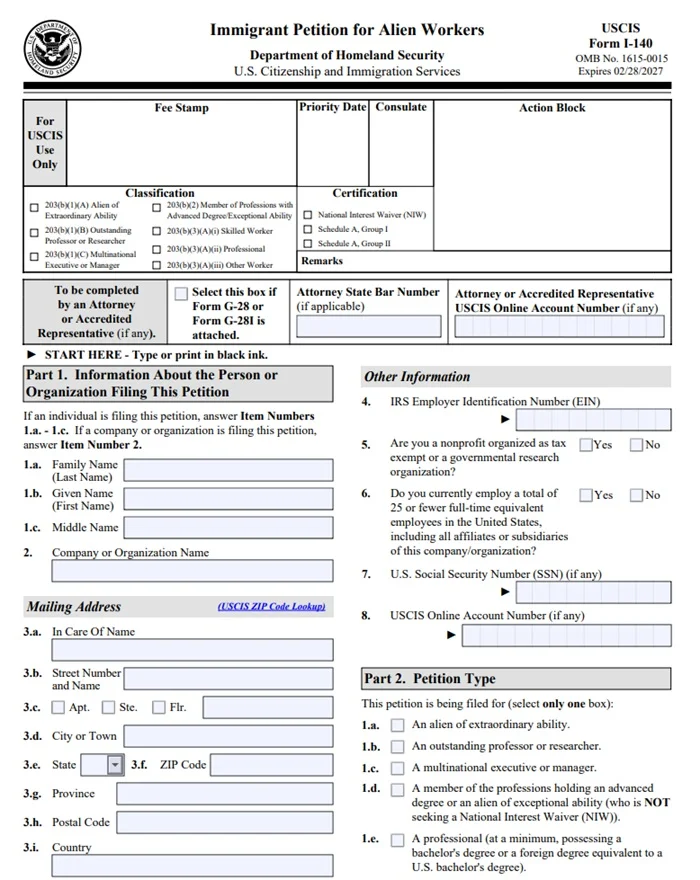
- the filing of Form ETA 9089
Only after PERM approval can the employer proceed with filing Form I-140 with USCIS.
Common I-140 issues and denial risks
Employment-based green card cases are often document-intensive and strategically complex. Common issues include:
- PERM recruitment errors
- inconsistencies between prior visa petitions and the green card filing
- insufficient proof of qualifications
- difficulties documenting executive or managerial duties
- problems proving the employer’s financial ability to pay
- timing issues involving visa retrogression and priority dates
Because many employment-based green card cases unfold over several years, long-term immigration planning is often essential from the beginning.
National Interest Waiver (NIW) and self-sponsored I-140 cases
Not all I-140 petitions require employer sponsorship.
Certain applicants may qualify to self-petition, particularly through
- EB-1A Extraordinary Ability cases,
- or EB-2 National Interest Waiver (NIW) petitions.
These categories can allow highly qualified professionals, entrepreneurs, researchers, physicians, or scientists to pursue permanent residence without a permanent job offer or PERM process.
However, these cases typically require highly strategic legal presentation and extensive supporting evidence.
Form I-140 lawyer: When you need legal support
Legal guidance is particularly important:
- for multinational companies
- executives and highly skilled professionals
- EB-1 and NIW applicants
- PERM-based sponsorship cases
- prior denials or RFEs
- long-term relocation planning to the United States
Employment-based immigration strategy often requires coordination between immigration planning, tax considerations, corporate structuring, and long-term mobility goals.
Advice on Form I-140
WINHELLER’s U.S. Desk supports companies and international professionals throughout the employment-based immigration process, from PERM strategy and I-140 preparation to long-term U.S. immigration planning.
If you have questions regarding Form I-140 or employment-based green cards, our team would be happy to assist you. If you need assistance with Form I-140 or other U.S. immigration law matters, our team is always available to advise you. Please feel free to contact us with your questions.
Please reach out to us at any time if you would like to schedule a consultation with one of our U.S. experts – either by e-mail (info@visum-usa.com) or by phone (+49 69 76 75 77 85 26).

Kari Foss-Persson
U.S. Attorney at Law (MN, USA) specialized in U.S. immigration and visa law
Over 10 years of experience in U.S. immigration law; Kari personally guides individuals and businesses through the entire visa process – in German and English.
How we can help
Specialized in U.S. visas for entrepreneurs and skilled professionals – personalized guidance and professional handling
Our counsel
- U.S. visa advice from licensed U.S. attorneys at law
- Guidance throughout your application process – worldwide
- Employee assignments to the United States
- Specialized in advicing entrepreneurs, investors, and skilled professionals
What you can expect
- Clear assessment of your chances of success
- Specific recommendations for your U.S. visa
- Efficient handling of your visa matter
- Prompt clarification of your individual situation
- Clarity on tax, corporate, and employment law
How we work
- Personalized consultations by phone or video conference
- Response within one business day to your inquiry
- Appointment with a U.S. attorney usually within 48 hours
- No obligation – no hidden fees